

Rekenbox · 2026
Car depreciation calculator
See yearly book value, tax depreciation and running costs, with a lease comparison.Value through the years
From purchase to residual value.
- Economic book value
- €25,200.00
- Tax book value
- €25,200.00
Buy or use operating lease?
€133.33 less per month with lease.
Residual value is your estimate. The chart shows book value; it does not predict a selling price.
- Depreciation basis after VAT treatment
- €30,000.00
- First calendar year economic depreciation
- €4,800.00
- First calendar year tax depreciation
- €4,800.00
- Useful life in whole months
- 60
- Annual running costs
- €4,000.00
- Annual total costs using selected method
- €8,800.00
- Costs allocated to business use per year
- €8,800.00
- Operating lease including the same costs per month
- €600.00
- Lease minus buying per month
- -€133.33
Findings and points to check
- Residual value is your input, not a market valuation. The comparison assumes operating lease with vehicle return; check mileage, final payments, costs and VAT basis in the offer.
Depreciation by calendar year
| Year | Months | Economic € | Tax € | Difference € | Book value € | Tax book value € | Cumulative € |
|---|---|---|---|---|---|---|---|
| 2026 | 12 | 4800.00 | 4800.00 | 0.00 | 25200.00 | 25200.00 | 4800.00 |
| 2027 | 12 | 4800.00 | 4800.00 | 0.00 | 20400.00 | 20400.00 | 9600.00 |
| 2028 | 12 | 4800.00 | 4800.00 | 0.00 | 15600.00 | 15600.00 | 14400.00 |
| 2029 | 12 | 4800.00 | 4800.00 | 0.00 | 10800.00 | 10800.00 | 19200.00 |
| 2030 | 12 | 4800.00 | 4800.00 | 0.00 | 6000.00 | 6000.00 | 24000.00 |
Assumptions, sources and version
2026 · nl-2026.1 · v2026.1
- The first-use month counts as a whole month, including 31 December. Useful life is rounded to whole months. This is a monthly model, not daily accounting.
- The tax comparison applies the ordinary 20% of original cost annual cap, down to residual value. The economic method or residual estimate is not automatically acceptable for tax.
- Depreciation and running costs exclude recoverable VAT. The business share allocates costs; it does not calculate company-car benefit, private-use VAT or asset classification.
- Belastingdienst — afschrijven op bedrijfsmiddelen (2026-09-07)
- Belastingdienst — margeregeling (2026-09-04)
- RVO — Milieulijst MIA/Vamil 2026 (2026-09-07)
Report for your records
Turn this into a complete PDF report.
Combine inputs, results, calculation rules and sources in a dossier for your accountant, lender or business customer.
- Result with the full calculation
- Assumptions and sources, so others can verify it
- Your inputs and calculation version recorded
The same calculation as above, fully documented. View the free preview first; you only pay when you want to download the report. See pricing
For the preview, we store your inputs encrypted on our server: 30 days without an account, or until you delete it once linked to your email.
Bulk · Calculate your entire list
Save on this device for free
Understand your result
How this tool works
Car depreciation allocates value consumed over the years you use a vehicle. You pay the purchase price when buying it, but that amount is not automatically a first-year expense. Residual value remains outside depreciation. This calculator places economic and tax book value side by side and connects depreciation with fuel, insurance and other vehicle costs.
Start with purchase price and the appropriate VAT basis. Fully recoverable purchase VAT is excluded from depreciable cost. A margin-scheme vehicle has no separately recoverable purchase VAT, so the entire entered margin price forms the basis. When you enter a price excluding VAT but cannot recover it, the model adds 21%. Enter residual value on the same VAT basis.
Straight-line depreciation spreads the difference between cost and residual value evenly over useful-life months. The first-use month counts as a complete month. Starting in October therefore gives three depreciation months in the first calendar year. The final year contains the remaining months. Useful life is rounded to whole months; this is not a day-by-day calculation.
Declining-balance depreciation applies a percentage to book value at the start of each year of use. The ordinary annual amount consequently decreases. In the final economic month, the calculator adjusts book value to your entered residual value. A low percentage can therefore produce a larger closing adjustment. Inspect that adjustment in the yearly table and substantiate why the method reflects actual value consumption.
The tax comparison caps ordinary depreciation at 20% of original cost annually, prorated for months and never below residual value. With a shorter economic useful life, tax book value may remain higher for longer. The schedule displays the remaining tax depreciation. This calculation does not automatically make your chosen economic method acceptable for tax purposes.
Cost per kilometer combines the chosen depreciation measure with annual running expenses. With zero kilometers, the kilometer result stays blank. The lease comparison assumes operating lease with vehicle return and comparable cost treatment. Company-car benefit, loan principal and private-use VAT are separate matters. Download the schedule or accounting journal entries and retain your underlying purchase information for the accountant.
Straight-line vehicle depreciation
(Purchase basis − residual value) ÷ useful-life months
Cumulative calculation rounds to cents and ends exactly at your entered residual value.
Compare tax depreciation
Ordinary annual tax ceiling = 20% × original cost
A short year uses the month fraction. Residual value can further limit depreciation.
Cost per kilometer and limitations
(Depreciation + annual running costs) ÷ kilometers
The business-use fraction allocates costs. It does not determine company-car benefit or investment relief.
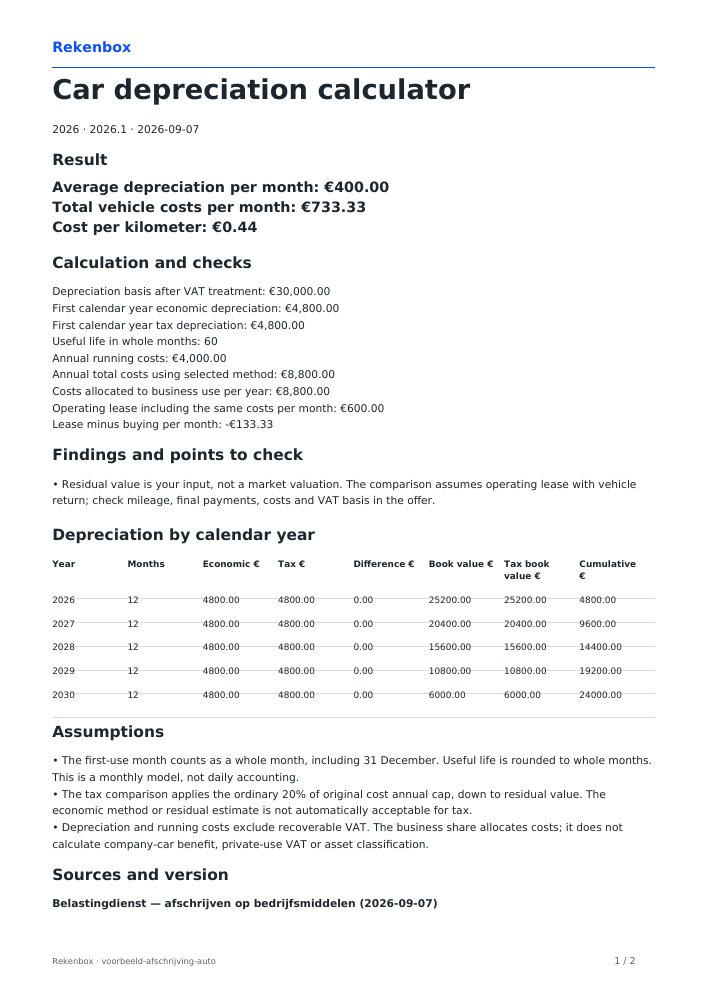
This PDF sample uses the visible example inputs. Your own download uses your entered information.
View sample · PDFCommon questions
How much does a car depreciate annually?
It depends on cost, residual value, useful life and method. Straight-line depreciation allocates the depreciable amount equally over months.
Can I depreciate a vehicle immediately?
This model applies the ordinary tax ceiling. Special schemes are not automatically applied; check their requirements separately.
Does VAT count towards depreciation?
Recoverable VAT does not. Nonrecoverable purchase VAT and the full price of a margin-scheme vehicle do form part of the basis.
Why can tax and economic book value differ?
The annual tax ceiling can be below economic depreciation, delaying expense recognition for tax purposes.
Does an electric car automatically qualify for environmental relief?
No. Check the precise vehicle code and the RVO Environment List for the order year.
Which details do you need?
- Vehicle purchase price
- Purchase price is
- Purchase VAT is fully recoverable
- Date first used
- Enter residual value as
- Your estimated residual value on the same VAT basis
- Residual value percentage
- Economic useful life (years)
- Name / registration
- Economic depreciation method
- Declining depreciation per year of use (%)
- Use tax depreciation in the cost summary
- Business use (%)
- Electric vehicle
- Annual kilometers, business and private combined
- Fuel / electricity per year
- Insurance per year
- Motor vehicle tax per year
- Maintenance per year
- Other annual vehicle costs
- Annual financing interest
- Monthly operating lease on the same VAT basis
- One-off lease costs
- Lease includes insurance, vehicle tax and maintenance
Limits of this tool
- The first-use month counts as a whole month, including 31 December. Useful life is rounded to whole months. This is a monthly model, not daily accounting.
- The tax comparison applies the ordinary 20% of original cost annual cap, down to residual value. The economic method or residual estimate is not automatically acceptable for tax.
- Depreciation and running costs exclude recoverable VAT. The business share allocates costs; it does not calculate company-car benefit, private-use VAT or asset classification.
Year: 2026 · Version 2026.1
Sources for this tool
- Belastingdienst — afschrijven op bedrijfsmiddelen · calculation source checked 2026-09-07
- Belastingdienst — margeregeling · calculation source checked 2026-09-04
- RVO — Milieulijst MIA/Vamil 2026 · calculation source checked 2026-09-07
Prepared by the Rekenbox product team at Winstwaker. The listed source references and calculation version make the method traceable. Report a content error Last updated: 2026-09-07. Rekenbox is a product by Winstwaker. The tool applies a calculation model to your inputs; a result or paid report is not a personal assessment by an adviser.