

Rekenbox · 2026
Selling price calculator
Turn purchase and labor costs into a price that covers costs, including margin, VAT and channel fees.Every euro has a destination
A price that works for you.
- Cost
- €15.00
- Channel and returns
- €0.00
- What remains
- €10.00
Suggested price incl. VAT, before discount
€30.99The suggestion rounds your consumer price up to the selected ending. Review the margin; your list price changes only when you adopt it.
How much room do you have?
Work backwards from market price
At the entered market price and target margin or markup, direct cost must not exceed: €15.00.
Margin at your current costs and that market price is 40%.
- Variable direct cost
- €15.00
- Overhead per unit
- €0.00
- Selling price excl. VAT after discount
- €25.00
- Gross profit before overhead and channel costs
- €10.00
- Gross profit margin (%)
- 40.00
- Expected return costs per unit
- €0.00
- Commission and payment fees per unit
- €0.00
- Margin after channel costs (%)
- 40
- Markup after channel costs (%)
- 66.67
- Product list revenue per period
- €2,500.00
- Product list profit per period
- €1,000.00
- Break-even units for first product
- 0
- Psychological list price incl. VAT
- €30.99
- Margin at suggested price (%)
- 41.43
- Maximum direct cost at market price and target
- €15.00
- Actual margin at market price (%)
- 40
Findings and points to check
- Profit here is before income or corporate tax. Return rates and volume are estimates. Tiers change the price; fixed overhead stays allocated using expected period sales.
Price list and margin
| Product | Units | Cost € | List excl. € | After discount incl. € | Margin % | Unit profit € |
|---|---|---|---|---|---|---|
| Voorbeeldproduct | 100 | 15.00 | 25.00 | 30.25 | 40.00 | 10.00 |
First product sensitivity
| Change | Unit profit € | Margin % |
|---|---|---|
| 10% higher purchase cost | 8.80 | 35.20 |
| 10 percentage points extra discount | 7.50 | 33.33 |
| 5 percentage points more returns | 10.00 | 40.00 |
First product quantity tiers
| From quantity | Extra discount % | Price excl. € | Price incl. € | Unit profit € | Profit at quantity € |
|---|---|---|---|---|---|
| 10 | 5 | 23.75 | 28.74 | 8.75 | 87.50 |
| 50 | 10 | 22.50 | 27.23 | 7.50 | 375.00 |
Assumptions, sources and version
2026 · nl-2026.1 · v2026.1
- Input costs exclude recoverable VAT. Percentage commission and payment fees apply to revenue after discount, excluding VAT.
- Fixed overhead is allocated equally per expected unit sold across the product list. Return costs are an explicit net cost estimate per return.
- Belastingdienst — btw-tarieven (2026-09-04)
Use your prices in the next step
Transfer product lines to a quote and enter customer details there. The break-even link uses the first product’s contribution and allocated overhead.
Report for your records
Turn this into a complete PDF report.
Combine inputs, results, calculation rules and sources in a dossier for your accountant, lender or business customer.
- Result with the full calculation
- Assumptions and sources, so others can verify it
- Your inputs and calculation version recorded
The same calculation as above, fully documented. View the free preview first; you only pay when you want to download the report. See pricing
For the preview, we store your inputs encrypted on our server: 30 days without an account, or until you delete it once linked to your email.
Bulk · Calculate your entire list
Save on this device for free
Understand your result
How this tool works
Choosing a selling price requires more than adding a percentage to purchase cost. You need to know what remains after expenses and discounts, and what the customer sees including VAT. This calculator therefore works backwards from target margin or markup. It then shows how sales-channel fees, returns and planned discounts affect the required list price.
For margin, selling price is the denominator. With a 40% target margin and €15 costs, those costs must represent 60% of the price. Dividing by 0.60 gives €25. A 40% markup instead multiplies €15 by 1.40, producing €21. Both methods are selectable, with their difference explained beside the input. A margin of 100% with costs has no finite solution and is rejected.
If you sell through a marketplace, enter commission and payment charges. Percentage channel fees are calculated on the amount actually paid, excluding VAT and after discounts. Check whether your channel uses that same basis. Commission charged on a VAT-inclusive amount requires a corresponding effective input rate. Expected return costs equal the return percentage multiplied by your entered cost per return, rather than an assumed refund of all revenue.
A planned discount raises the required list price if the margin target must remain intact. The price after discount determines VAT and net profit. Quantity tiers apply a further discount to that price. They do not reallocate fixed overhead, which remains based on expected volume. This reveals whether an attractive quantity offer still contributes enough towards the business.
You can also start from an existing market price. The result shows remaining margin with current costs and maximum direct cost at your target. Psychological pricing rounds the VAT-inclusive consumer list price upwards to a .95 or .99 ending. The margin effect is recalculated. A suggestion never silently overwrites your entered market price.
Download a customer price list without internal costing, or retain the complete result for your team. Transfer product lines to a quote and review customer details and numbering there. No calculator knows what customers will pay. Combine the result with competition, customer value and actual sales before introducing your new prices.
Calculate selling price from margin
Discounted price = cost ÷ (1 − margin − percentage channel fees)
Cost here includes full unit cost, expected return costs and fixed payment fees.
Keep list price and VAT visible
List price = required price ÷ (1 − discount)
VAT applies to the actual paid price. Suggested endings apply to the list price including VAT.
A market price does not guarantee profit
Net profit = paid price − all entered costs
The sensitivity table still shows a loss when a competitor or marketplace describes the price as attractive.
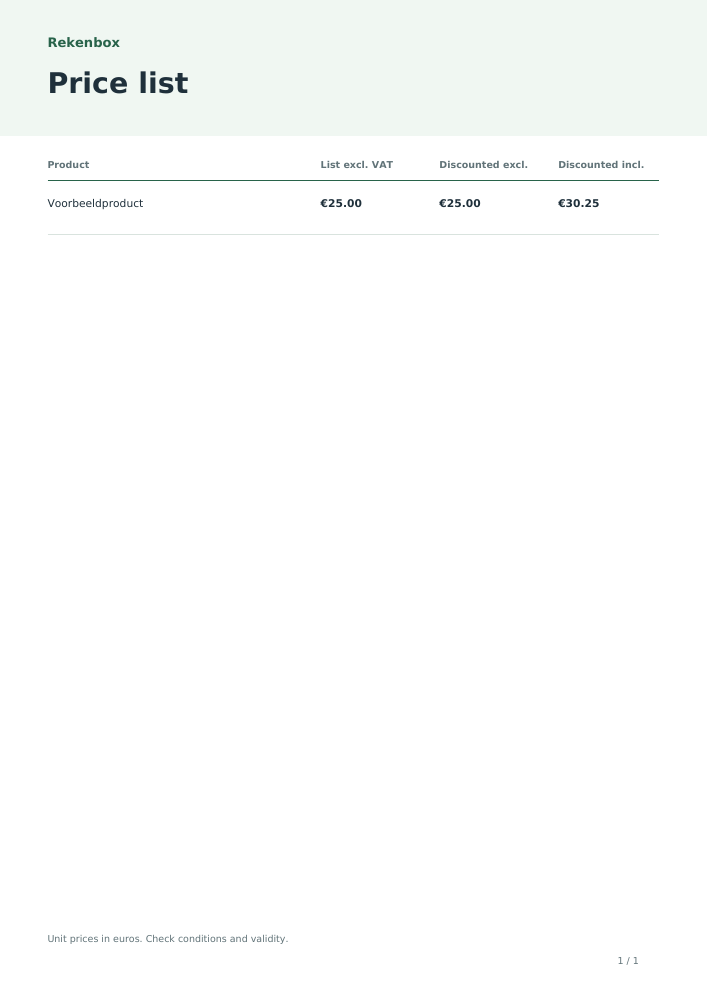
This PDF sample uses the visible example inputs. Your own download uses your entered information.
View sample · PDFCommon questions
How do I calculate a VAT-inclusive selling price?
Multiply the discounted price by 1.21, 1.09 or 1.00 for the selected rate.
Why is 40% markup not 40% margin?
Markup divides profit by cost; margin divides profit by revenue. At €15 cost, 40% markup gives a €21 price and 28.57% margin.
Can I include marketplace commissions?
Yes, enter the actual commission. The model uses the discounted price excluding VAT as its basis.
What does psychological price rounding do?
The tool rounds upwards to the chosen ending and recalculates margin. Adopt the suggestion yourself.
Does the customer price list contain my costs?
No. The separate price list contains products and selling prices. The complete result includes your cost analysis.
Which details do you need?
- Product
- Purchase / materials per unit
- Labor hours per unit
- Labor hourly rate
- Packaging and shipping
- Other direct costs
- Expected units per period
- Market price excl. VAT, before discount
- Calculate from
- Target margin / markup (%) — Margin divides profit by selling price; markup divides profit by cost. Both include channel costs.
- VAT rate
- Work backwards from the market price
- Allocate overhead as
- Fixed overhead per period
- Overhead markup (%)
- Marketplace commission (%)
- Payment fees (%)
- Fixed payment fee per unit sold
- Expected return rate (%)
- Net additional cost per return — All extra costs and unrecovered revenue of one return, after any resale. No refund is assumed.
- Expected discount (%)
- Psychological consumer price
- Enter multiple products
- Products
- Quantity tiers for the first product
Limits of this tool
- Input costs exclude recoverable VAT. Percentage commission and payment fees apply to revenue after discount, excluding VAT.
- Fixed overhead is allocated equally per expected unit sold across the product list. Return costs are an explicit net cost estimate per return.
Year: 2026 · Version 2026.1
Sources for this tool
- Belastingdienst — btw-tarieven · calculation source checked 2026-09-04
Prepared by the Rekenbox product team at Winstwaker. The listed source references and calculation version make the method traceable. Report a content error Last updated: 2026-09-07. Rekenbox is a product by Winstwaker. The tool applies a calculation model to your inputs; a result or paid report is not a personal assessment by an adviser.