

Rekenbox · 2026
Cost price calculator
Turn purchase and labor costs into a price that covers costs, including margin, VAT and channel fees.Example calculation — adjust the amounts to your situation.Selling price calculated with 40% margin and 21% VAT. Change under “Also calculate your selling price”.
Every euro has a destination
A price that works for you.
- Cost
- €15.00
- Channel and returns
- €0.00
- What remains
- €10.00
Suggested price incl. VAT, before discount
€30.99The suggestion rounds your consumer price up to the selected ending. Review the margin; your list price changes only when you adopt it.
How much room do you have?
Work backwards from market price
At the entered market price and target margin or markup, direct cost must not exceed: €15.00.
Margin at your current costs and that market price is 40%.
- Variable direct cost
- €15.00
- Overhead per unit
- €0.00
- Selling price excl. VAT after discount
- €25.00
- Gross profit before overhead and channel costs
- €10.00
- Gross profit margin (%)
- 40.00
- Expected return costs per unit
- €0.00
- Commission and payment fees per unit
- €0.00
- Margin after channel costs (%)
- 40
- Markup after channel costs (%)
- 66.67
- Product list revenue per period
- €2,500.00
- Product list profit per period
- €1,000.00
- Break-even units for first product
- 0
- Psychological list price incl. VAT
- €30.99
- Margin at suggested price (%)
- 41.43
- Maximum direct cost at market price and target
- €15.00
- Actual margin at market price (%)
- 40
Findings and points to check
- Profit here is before income or corporate tax. Return rates and volume are estimates. Tiers change the price; fixed overhead stays allocated using expected period sales.
Price list and margin
| Product | Units | Cost € | List excl. € | After discount incl. € | Margin % | Unit profit € |
|---|---|---|---|---|---|---|
| Voorbeeldproduct | 100 | 15.00 | 25.00 | 30.25 | 40.00 | 10.00 |
First product sensitivity
| Change | Unit profit € | Margin % |
|---|---|---|
| 10% higher purchase cost | 8.80 | 35.20 |
| 10 percentage points extra discount | 7.50 | 33.33 |
| 5 percentage points more returns | 10.00 | 40.00 |
First product quantity tiers
| From quantity | Extra discount % | Price excl. € | Price incl. € | Unit profit € | Profit at quantity € |
|---|---|---|---|---|---|
| 10 | 5 | 23.75 | 28.74 | 8.75 | 87.50 |
| 50 | 10 | 22.50 | 27.23 | 7.50 | 375.00 |
Assumptions, sources and version
2026 · nl-2026.1 · v2026.1
- Input costs exclude recoverable VAT. Percentage commission and payment fees apply to revenue after discount, excluding VAT.
- Fixed overhead is allocated equally per expected unit sold across the product list. Return costs are an explicit net cost estimate per return.
- Belastingdienst — btw-tarieven (2026-09-04)
Use your prices in the next step
Transfer product lines to a quote and enter customer details there. The break-even link uses the first product’s contribution and allocated overhead.
Report for your records
Turn this into a complete PDF report.
Combine inputs, results, calculation rules and sources in a dossier for your accountant, lender or business customer.
- Result with the full calculation
- Assumptions and sources, so others can verify it
- Your inputs and calculation version recorded
The same calculation as above, fully documented. View the free preview first; you only pay when you want to download the report. See pricing
For the preview, we store your inputs encrypted on our server: 30 days without an account, or until you delete it once linked to your email.
Bulk · Calculate your entire list
Save on this device for free
Understand your result
How this tool works
Calculating cost price starts with what one saleable product actually costs. The supplier invoice is rarely enough. Include labor, packaging, shipping and other direct costs, then allocate costs that serve the wider business or product group. This produces a full cost alongside variable direct cost. It helps assess whether your price leaves sufficient room at the expected sales volume.
Enter amounts excluding recoverable VAT. Labor equals hours per unit multiplied by an hourly rate. Your own time also has economic value: entering zero is a deliberate assumption rather than automatic profit. Packaging and shipping share one input. Record additional expenses under other direct costs and describe what you included when you save a scenario for later review.
There are two overhead methods. A fixed amount per period is divided by total expected units across the product list, giving every unit the same allocation. A percentage instead adds overhead to each article’s direct cost. These allocation rules answer different questions. Choose the method that reflects your operations and make sure sales volume and fixed overhead cover the same period.
Target margin means profit after entered channel and return costs divided by the selling price excluding VAT. Markup has a different denominator: the full cost basis including expected return costs and fixed payment fees. A 40% margin therefore requires a higher selling price than a 40% markup. Percentage commissions are included when solving the price needed to achieve your target.
Use the product table for several articles and review a CSV import before replacing the existing list. Margin, VAT, overhead policy and channel assumptions are shared; direct costs and expected volume belong to each product. Sensitivity calculations hold your selling price constant and show the impact of higher purchase costs, extra discounts or more returns. Quantity tiers show additional volume discounts.
This is a pricing model before personal income or corporate tax. Sales volume is an estimate, not a guaranteed order book. Download a customer price list or the complete result for internal discussion. The detailed report also records inputs, sources and calculation version, helping a colleague understand how the result was produced.
Full cost per unit
Direct costs + overhead ÷ units
Fixed overhead is allocated across the total period volume of all entered articles.
Margin and markup use different denominators
Margin = profit ÷ selling price; markup = profit ÷ cost
With €15 cost and €25 price, margin is 40% and markup is 66.67%, with no channel costs.
Limits of your pricing model
Period profit = unit profit × expected units
Unit costs are rounded to cents. Substantiate your volume and return assumptions.
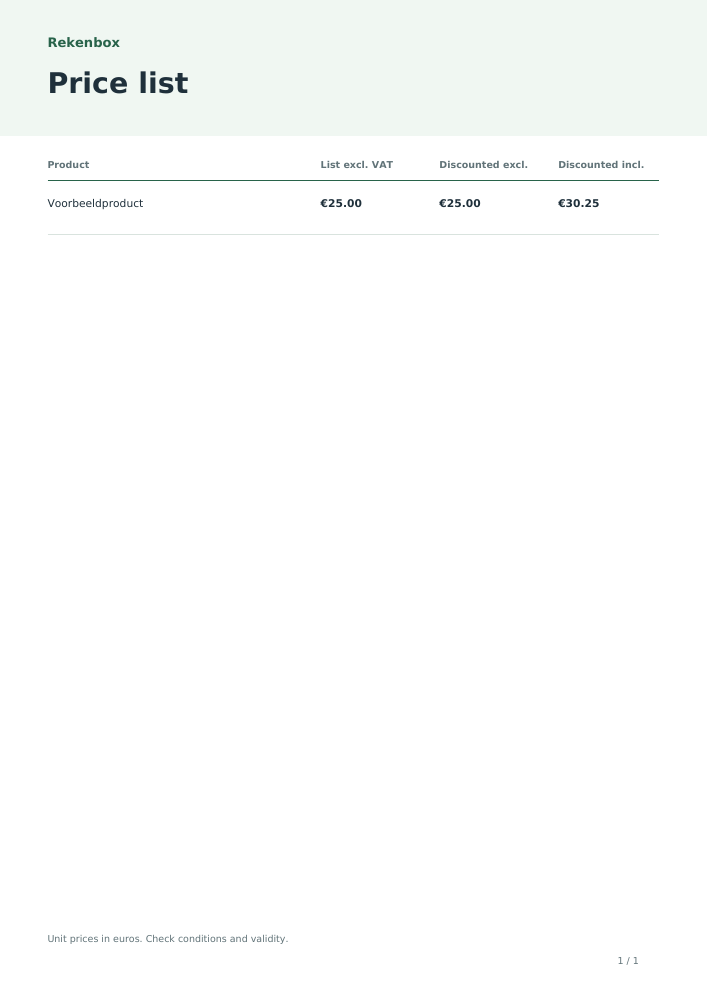
This PDF sample uses the visible example inputs. Your own download uses your entered information.
View sample · PDFCommon questions
How do you calculate cost per unit?
Add direct costs and an appropriate overhead allocation. Use the same period for sales volume and fixed costs.
What is the difference between variable and full cost?
Full cost includes allocated overhead in addition to direct variable expenses.
Does my own labor count as a cost?
For economic costing, yes. Enter hours and a suitable hourly rate even if you do not pay yourself a salary.
Can I import several products?
Yes, use the CSV template and review the import. Up to 25 table rows are available without an account.
What is a healthy gross margin?
There is no universal benchmark. Required margin depends on overhead, channel fees, risk and volume.
Which details do you need?
- Product
- Purchase / materials per unit
- Labor hours per unit
- Labor hourly rate
- Packaging and shipping
- Other direct costs
- Expected units per period
- Market price excl. VAT, before discount
- Calculate from
- Target margin / markup (%) — Margin divides profit by selling price; markup divides profit by cost. Both include channel costs.
- VAT rate
- Work backwards from the market price
- Allocate overhead as
- Fixed overhead per period
- Overhead markup (%)
- Marketplace commission (%)
- Payment fees (%)
- Fixed payment fee per unit sold
- Expected return rate (%)
- Net additional cost per return — All extra costs and unrecovered revenue of one return, after any resale. No refund is assumed.
- Expected discount (%)
- Psychological consumer price
- Enter multiple products
- Products
- Quantity tiers for the first product
Limits of this tool
- Input costs exclude recoverable VAT. Percentage commission and payment fees apply to revenue after discount, excluding VAT.
- Fixed overhead is allocated equally per expected unit sold across the product list. Return costs are an explicit net cost estimate per return.
Year: 2026 · Version 2026.1
Sources for this tool
- Belastingdienst — btw-tarieven · calculation source checked 2026-09-04
Prepared by the Rekenbox product team at Winstwaker. The listed source references and calculation version make the method traceable. Report a content error Last updated: 2026-09-07. Rekenbox is a product by Winstwaker. The tool applies a calculation model to your inputs; a result or paid report is not a personal assessment by an adviser.