

Rekenbox · 2026
Financial plan generator
Create four connected budgets. See profit, funding and cash for 12 to 36 months.Looking ahead
Room to run your business.
Cash at each month end. Select a bar for amounts; red means additional funds are needed.
- Closing cash
- €2,858.34
- Receipts
- €136.62
- Profit
- €270.00
- Principal
- €143.33
View ratios for your closing balance and last twelve forecast months. Other loans are treated conservatively as current debt; review their maturity. Supply historical comparatives yourself.
- Company
- Voorbeeld Webshop
- Scenario
- Base
- Scenario revenue change (%)
- 0
- Scenario cost change (%)
- 0
- Plan horizon
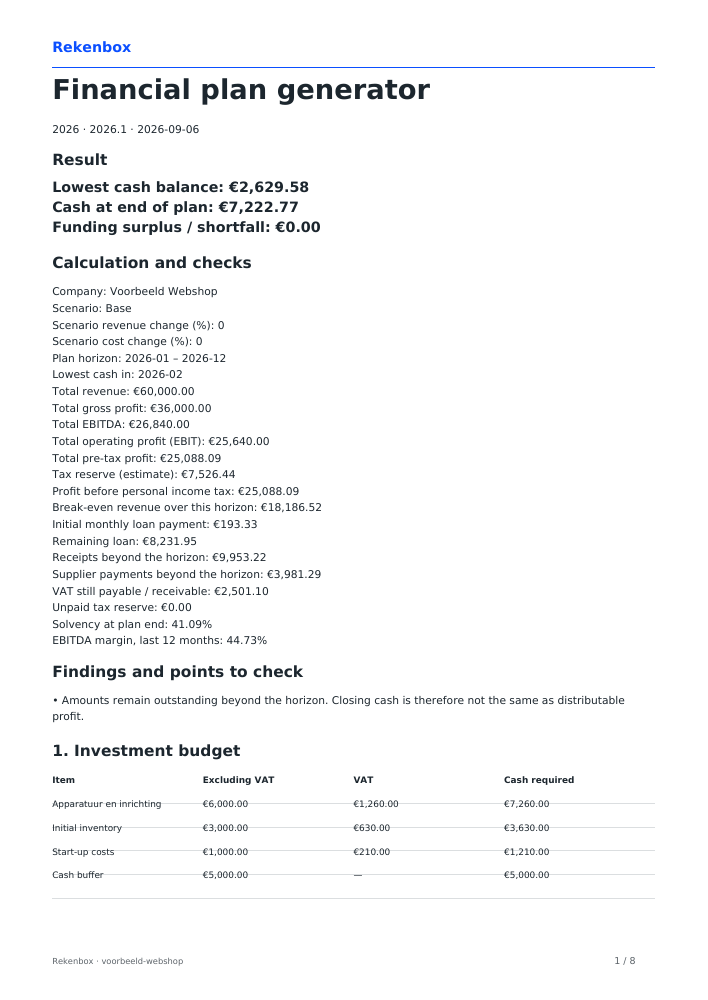
- 2026-01 – 2026-12
- Lowest cash in
- 2026-02
- Total revenue
- €60,000.00
- Total gross profit
- €36,000.00
- Total EBITDA
- €26,840.00
- Total operating profit (EBIT)
- €25,640.00
- Total pre-tax profit
- €25,088.09
- Tax reserve (estimate)
- €7,526.44
- Profit before personal income tax
- €25,088.09
- Break-even revenue over this horizon
- €18,186.52
- Initial monthly loan payment
- €193.33
- Remaining loan
- €8,231.95
- Receipts beyond the horizon
- €9,953.22
- Supplier payments beyond the horizon
- €3,981.29
- VAT still payable / receivable
- €2,501.10
- Unpaid tax reserve
- €0.00
- Solvency at plan end
- 41.09%
- EBITDA margin, last 12 months
- 44.73%
Findings and points to check
- Amounts remain outstanding beyond the horizon. Closing cash is therefore not the same as distributable profit.
1. Investment budget
| Item | Excluding VAT | VAT | Cash required |
|---|---|---|---|
| Apparatuur en inrichting | €6,000.00 | €1,260.00 | €7,260.00 |
| Initial inventory | €3,000.00 | €630.00 | €3,630.00 |
| Start-up costs | €1,000.00 | €210.00 | €1,210.00 |
| Cash buffer | €5,000.00 | — | €5,000.00 |
2. Financing budget
| Funding source | Amount |
|---|---|
| Owner capital | €7,100.00 |
| Loan | €10,000.00 |
| Other funding | €0.00 |
| Total available | €17,100.00 |
| Required including buffer | €17,100.00 |
| Surplus / shortfall | €0.00 |
3. Monthly operating budget
| Month | Revenue | Cost of goods | Gross profit | Fixed costs | Start-up costs | Depreciation | EBIT | Interest | Pre-tax profit | Tax reserve | Profit before personal income tax |
|---|---|---|---|---|---|---|---|---|---|---|---|
| 2026-01 | €3,500.00 | €1,400.00 | €2,100.00 | €680.00 | €1,000.00 | €100.00 | €320.00 | €50.00 | €270.00 | €81.00 | €270.00 |
| 2026-02 | €3,500.00 | €1,400.00 | €2,100.00 | €680.00 | €0.00 | €100.00 | €1,320.00 | €49.28 | €1,270.72 | €381.22 | €1,270.72 |
| 2026-03 | €4,000.00 | €1,600.00 | €2,400.00 | €680.00 | €0.00 | €100.00 | €1,620.00 | €48.56 | €1,571.44 | €471.43 | €1,571.44 |
| 2026-04 | €4,000.00 | €1,600.00 | €2,400.00 | €680.00 | €0.00 | €100.00 | €1,620.00 | €47.84 | €1,572.16 | €471.65 | €1,572.16 |
| 2026-05 | €4,500.00 | €1,800.00 | €2,700.00 | €680.00 | €0.00 | €100.00 | €1,920.00 | €47.11 | €1,872.89 | €561.87 | €1,872.89 |
| 2026-06 | €4,500.00 | €1,800.00 | €2,700.00 | €680.00 | €0.00 | €100.00 | €1,920.00 | €46.38 | €1,873.62 | €562.09 | €1,873.62 |
| 2026-07 | €4,500.00 | €1,800.00 | €2,700.00 | €680.00 | €0.00 | €100.00 | €1,920.00 | €45.65 | €1,874.35 | €562.31 | €1,874.35 |
| 2026-08 | €4,500.00 | €1,800.00 | €2,700.00 | €680.00 | €0.00 | €100.00 | €1,920.00 | €44.91 | €1,875.09 | €562.53 | €1,875.09 |
| 2026-09 | €5,500.00 | €2,200.00 | €3,300.00 | €680.00 | €0.00 | €100.00 | €2,520.00 | €44.17 | €2,475.83 | €742.75 | €2,475.83 |
| 2026-10 | €6,000.00 | €2,400.00 | €3,600.00 | €680.00 | €0.00 | €100.00 | €2,820.00 | €43.42 | €2,776.58 | €832.97 | €2,776.58 |
| 2026-11 | €7,000.00 | €2,800.00 | €4,200.00 | €680.00 | €0.00 | €100.00 | €3,420.00 | €42.67 | €3,377.33 | €1,013.20 | €3,377.33 |
| 2026-12 | €8,500.00 | €3,400.00 | €5,100.00 | €680.00 | €0.00 | €100.00 | €4,320.00 | €41.92 | €4,278.08 | €1,283.42 | €4,278.08 |
Operating budget by forecast year
| Forecast year | Revenue | Cost of goods | Gross profit | Fixed costs | Start-up costs | Depreciation | EBIT | Interest | Pre-tax profit | Tax reserve | Profit before personal income tax |
|---|---|---|---|---|---|---|---|---|---|---|---|
| 1 | €60,000.00 | €24,000.00 | €36,000.00 | €8,160.00 | €1,000.00 | €1,200.00 | €25,640.00 | €551.91 | €25,088.09 | €7,526.44 | €25,088.09 |
4. Cash-flow forecast
| Month | Opening cash | Funding | Customer receipts | Suppliers | Operating payments | Initial spending | Interest | Principal | VAT paid / refunded | Income/corporate tax paid | Personal drawings | Closing cash |
|---|---|---|---|---|---|---|---|---|---|---|---|---|
| 2026-01 | €0.00 | €17,100.00 | €136.62 | €54.65 | €749.30 | €12,100.00 | €50.00 | €143.33 | €0.00 | €81.00 | €1,200.00 | €2,858.34 |
| 2026-02 | €2,858.34 | €0.00 | €3,825.16 | €1,530.07 | €749.30 | €0.00 | €49.28 | €144.05 | €0.00 | €381.22 | €1,200.00 | €2,629.58 |
| 2026-03 | €2,629.58 | €0.00 | €4,664.35 | €1,865.74 | €749.30 | €0.00 | €48.56 | €144.77 | €0.00 | €471.43 | €1,200.00 | €2,814.13 |
| 2026-04 | €2,814.13 | €0.00 | €4,683.87 | €1,873.54 | €749.30 | €0.00 | €47.84 | €145.49 | €0.00 | €471.65 | €1,200.00 | €3,010.18 |
| 2026-05 | €3,010.18 | €0.00 | €5,015.65 | €2,006.26 | €749.30 | €0.00 | €47.11 | €146.22 | -€921.90 | €561.87 | €1,200.00 | €4,236.97 |
| 2026-06 | €4,236.97 | €0.00 | €5,269.35 | €2,107.74 | €749.30 | €0.00 | €46.38 | €146.95 | €0.00 | €562.09 | €1,200.00 | €4,693.86 |
| 2026-07 | €4,693.86 | €0.00 | €5,620.65 | €2,248.26 | €749.30 | €0.00 | €45.65 | €147.68 | €1,430.10 | €562.31 | €1,200.00 | €3,931.21 |
| 2026-08 | €3,931.21 | €0.00 | €5,445.00 | €2,178.00 | €749.30 | €0.00 | €44.91 | €148.42 | €0.00 | €562.53 | €1,200.00 | €4,493.05 |
| 2026-09 | €4,493.05 | €0.00 | €5,269.35 | €2,107.74 | €749.30 | €0.00 | €44.17 | €149.16 | €0.00 | €742.75 | €1,200.00 | €4,769.28 |
| 2026-10 | €4,769.28 | €0.00 | €6,889.20 | €2,755.68 | €749.30 | €0.00 | €43.42 | €149.91 | €1,619.10 | €832.97 | €1,200.00 | €4,308.10 |
| 2026-11 | €4,308.10 | €0.00 | €7,025.80 | €2,810.32 | €749.30 | €0.00 | €42.67 | €150.66 | €0.00 | €1,013.20 | €1,200.00 | €5,367.75 |
| 2026-12 | €5,367.75 | €0.00 | €8,801.78 | €3,520.71 | €749.30 | €0.00 | €41.92 | €151.41 | €0.00 | €1,283.42 | €1,200.00 | €7,222.77 |
Supporting your plan
| Item | Explanation |
|---|---|
| Business and plan | Startende webshop. Deze voorbeeldcijfers vervangen geen marktonderzoek. |
| Revenue and seasonality assumptions | Jaar 1: €60.000 omzet exclusief btw. Controleer bezoekers, conversie, orderwaarde en verkoopkanalen. |
| Cost and investment assumptions | Vervang voorbeeldbedragen door offertes en contracten. Beginvoorraad wordt in het model op peil gehouden. |
| Funding purpose and terms | €10.000 lening voor de start, 60 maanden, 6% rente. Controleer voorwaarden en zekerheden bij je financier. |
| Risks and mitigations | Bekijk ook het voorzichtige scenario en late klantbetalingen. Beoordeel de kaspositie elke maand. |
Assumptions, sources and version
2026 · financial-plan-1.0 · v2026.1
- Indicative financial plan using your inputs; no financing approval or accountant’s assurance. The structure follows KVK and Qredits’ four budgets; Rekenbox is not affiliated with them.
- The plan starts on the first day of a month. Assets, initial inventory, start-up spending and financing occur at the start. Inventory is then maintained: purchases follow budgeted cost of sales. Depreciation is straight-line over the entered useful life and is not a tax deduction claim.
- Revenue and purchases are spread evenly across each month’s days; payment terms shift receipt or payment by the entered number of days. Fixed costs, salary and drawings are paid in the same month. Outstanding balances remain visible at the end.
- The VAT model uses invoice accounting, one sales and purchase rate, recoverable input VAT and calendar quarters or months. VAT payable falls in the next month; refunds follow your entered delay. With VAT disabled, purchase VAT increases costs and investments. KOR, cross-border VAT, private use and partial recovery need separate calculations.
- The income/corporate tax reserve is your planning percentage of positive profit. It is not a full tax assessment or loss-offset calculation. Sole-trader income tax is personal: the reserve reduces available cash, not business profit. For a BV we also show profit after the corporate-tax reserve.
- KVK — financieel plan (2026-09-06)
- KVK — exploitatiebegroting (2026-09-06)
- Qredits — financieel plan voorbeeld (2026-09-06)
- Belastingdienst — btw-aangifte en betaling (2026-09-06)
Report for your records
Turn this into a complete PDF report.
Financial plan PDF for your bank or Qredits application: all four budgets, monthly figures, funding headroom and your explanations, with sources and calculation version. €19 including VAT per dossier; included with access. The lender makes its own lending decision.
- Result with the full calculation
- Assumptions and sources, so others can verify it
- Your inputs and calculation version recorded
The same calculation as above, fully documented. View the free preview first; you only pay when you want to download the report. See pricing
For the preview, we store your inputs encrypted on our server: 30 days without an account, or until you delete it once linked to your email.
Bulk · Calculate your entire list
Save on this device for free
Understand your result
How this tool works
A financial plan turns your business plan into connected numbers: what you need to start, how you fund it, the profit you expect and when cash arrives. This free financial plan generator calculates four linked budgets over twelve, twenty-four or thirty-six months. Use it for a new business or to explore the consequences of an investment.
Start with your business and first month. Revenue is entered month by month, allowing for quiet and busy periods. The worked example is a webshop with €60,000 revenue in its first year. Replace its seasonal pattern with sales volumes multiplied by a realistic selling price. Spreading an annual figure evenly over twelve months may conceal pressure on cash. Years two and three can have their own revenue growth, while fixed costs use a separate growth assumption.
Next enter investment needs and funding sources. Equipment, initial inventory, start-up costs and your target cash buffer determine the money required at launch. VAT paid upfront forms part of that cash requirement. Owner capital, a loan and other funding provide the cover. A shortfall remains visible and is never filled by an invented loan. Depreciation follows purchase cost, residual value and useful life; interest and principal payments follow the entered loan terms.
The operating budget uses revenue excluding VAT, cost of sales, staff costs and other operating expenses. For a sole trader, personal drawings are not a business expense. For a BV, the entered director salary is included in operating costs. The income or corporate tax percentage is your planning reserve, not a full tax assessment. Use the tax calculators as well and replace example percentages with an appropriate expectation.
The cash-flow forecast follows the actual calendar. Revenue and purchases are distributed over each month’s days, then payment terms shift the cash date. VAT accumulates by month or calendar quarter. VAT payable falls in the following month, while a refund follows your selected delay. This also handles a November start and amounts arriving after the forecast horizon. The lowest cash balance helps you assess possible additional funding.
Compare base, cautious and optimistic scenarios, or enter your own sensitivity. Cautious reduces revenue by 20% and increases fixed operating costs by 10%; optimistic uses 20% more revenue and 5% higher fixed costs. Keep evidence for your assumptions, update the plan monthly and discuss the dossier with your lender. Free PDF and Excel downloads show the numbers. The optional report also records inputs, explanations, sources and the calculation version for a financing application.
Financial plan for a business plan
The fictional webshop starts with €6,000 equipment, €3,000 inventory and €1,000 start-up costs, each excluding 21% VAT. Adding a €5,000 cash buffer gives €17,100 funding required: €7,100 owner capital and a €10,000 loan. Annual revenue is €60,000 and cost of sales is 40%. The tool contains the full example.
Funding and start-up budget
This plan includes investment, funding, operating profit and cash flow. Add revenue evidence, quotations, terms and risks; a lender may request further information.
Common questions
Which budgets does a lender expect?
This plan includes investment, funding, operating profit and cash flow. Add revenue evidence, quotations, terms and risks; a lender may request further information.
How do I create a financial plan as a start-up?
Start with investment needs and available funding. Forecast monthly sales and costs, review cash balances and document why the assumptions are realistic. The webshop example walks through each part.
Can I use my existing forecast?
Yes. Read a XAF through Start from your accounts and review its period and account classifications. Explicitly apply historical revenue and average costs, then separate the cost categories further.
Can I download the financial plan PDF for free?
Yes, the standard PDF and Excel are free. An optional €19 report also records inputs, explanations, sources and calculation version. Existing access adds features including scenarios, versions and branding.
Does this guarantee financing approval?
No. The tool calculates from your own assumptions. The lender independently assesses the business, evidence and conditions; the PDF is not an accountant’s assurance statement.
Which details do you need?
- Actual monthly cash movements
- Company name
- Starting month (first day)
- Horizon
- Legal form
- Monthly year-one revenue excluding VAT
- Revenue growth year 2 (%)
- Revenue growth year 3 (%)
- Annual fixed-cost growth (%)
- Scenario
- Custom revenue change (%)
- Custom fixed-cost change (%)
- Fixed assets at the start
- Initial inventory excluding VAT
- VAT on initial inventory (%)
- One-off start-up costs excluding VAT
- VAT on start-up costs (%)
- Target cash buffer after initial spending
- Owner capital
- Initial loan
- Annual loan interest (%)
- Loan term in months
- Repayment
- Other funding
- Type of other funding
- Cost of goods as % of revenue
- Staff including employer costs per month
- VAT on staff including employer costs (%)
- Premises per month
- VAT on premises (%)
- Marketing per month
- VAT on marketing (%)
- Insurance per month
- VAT on insurance (%)
- Administration per month
- VAT on administration (%)
- Other operating costs per month
- VAT on other operating costs (%)
- Monthly personal drawings (sole trader)
- Monthly gross director salary (BV)
- Director employer-cost allowance (%)
- Income/corporate tax reserve on positive profit (%)
- Customer payment term in days
- Supplier payment term in days
- Charge VAT and fully reclaim input VAT
- Sales VAT (%)
- Purchases VAT (%)
- VAT return period
- Expected VAT refund: months after period
- Cash tax reserve payments
- Business and plan
- Revenue and seasonality assumptions
- Cost and investment assumptions
- Funding purpose and terms
- Risks and mitigations
Limits of this tool
- Indicative financial plan using your inputs; no financing approval or accountant’s assurance. The structure follows KVK and Qredits’ four budgets; Rekenbox is not affiliated with them.
- The plan starts on the first day of a month. Assets, initial inventory, start-up spending and financing occur at the start. Inventory is then maintained: purchases follow budgeted cost of sales. Depreciation is straight-line over the entered useful life and is not a tax deduction claim.
- Revenue and purchases are spread evenly across each month’s days; payment terms shift receipt or payment by the entered number of days. Fixed costs, salary and drawings are paid in the same month. Outstanding balances remain visible at the end.
- The VAT model uses invoice accounting, one sales and purchase rate, recoverable input VAT and calendar quarters or months. VAT payable falls in the next month; refunds follow your entered delay. With VAT disabled, purchase VAT increases costs and investments. KOR, cross-border VAT, private use and partial recovery need separate calculations.
- The income/corporate tax reserve is your planning percentage of positive profit. It is not a full tax assessment or loss-offset calculation. Sole-trader income tax is personal: the reserve reduces available cash, not business profit. For a BV we also show profit after the corporate-tax reserve.
Year: 2026 · Version 2026.1
Sources for this tool
- KVK — financieel plan · calculation source checked 2026-09-06
- KVK — exploitatiebegroting · calculation source checked 2026-09-06
- Qredits — financieel plan voorbeeld · calculation source checked 2026-09-06
- Belastingdienst — btw-aangifte en betaling · calculation source checked 2026-09-06
Prepared by the Rekenbox product team at Winstwaker. The listed source references and calculation version make the method traceable. Report a content error Last updated: 2026-09-06. Rekenbox is a product by Winstwaker. The tool applies a calculation model to your inputs; a result or paid report is not a personal assessment by an adviser.